
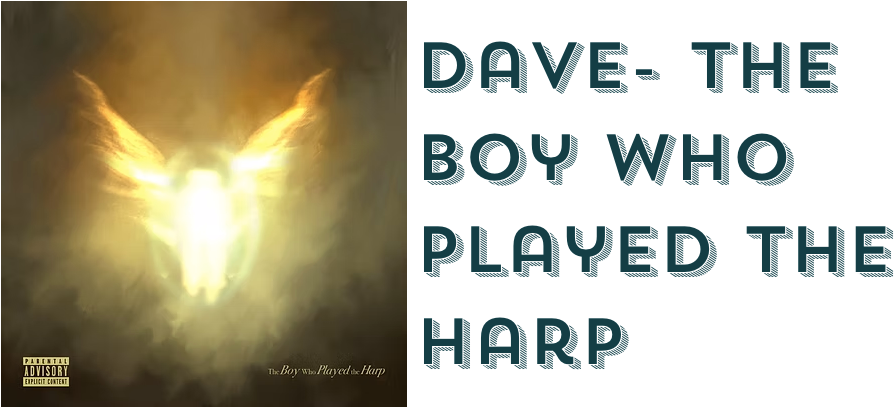
Never has there been a greater underdog story in rap than Dave: at the very least, you have to concede that his rise to fame has been far from predictable. Dave has, in 2025, three studio albums to his name, and each is as bleak, despairing and introspective as the last. Though it’s the accessible style of hits like ‘Sprinter’ and ‘Location’ that’s pushed him into the public eye, the rapper’s best material has always been his most vulnerable— new album ‘The Boy Who Played the Harp’ may struggle for a distinct musical language, but the sheer weight of emotion the record will bring upon you more than compensates.
Anyone who only knows Dave for his collaborative EP with Central Cee may be blindsided by the mellow ambience of ‘History,’ and gobsmacked at the depths of character the record goes on to descend to. The follow-up to 2021’s ‘We’re All Alone In This Together’ is finally here, packed with yet more instances of pointed social commentary and hard-hitting self-dissection. To that end, the conscious lyrical themes of ‘The Boy Who Played the Harp’ are undoubtedly its main (and pivotal) aspect, so much so that every other layer of the album revolves around them: Dave wants you to feel something, and that emotion is his singular aim. The album’s ‘music’— its flows, beats and instrumental choices— are purposefully withdrawn, even by the standards of this discography: often, it feels like the rapper was afraid of distracting from his introspection with intricate beat switches and show-stopping producer tags. As you might expect then, ‘The Boy Who Played the Harp’ is a record to really be listened to: there is so much more to enjoy beneath the surface than there is on the face of things.
If the album can be criticised, its for just how muted and pulled-back so many of its musical choices can be— Dave doesn’t quite commit to a lo-fi sound here, but neither is he bringing the musical excess of cuts like ‘In The Fire’ or ‘Psycho.’ The record’s acoustic instrumentation, whether it be the mournful grand piano of ‘Selfish’ or the clean guitar lines of ‘Fairchild,’ is extremely well-captured, and tends to fit each cut incredibly snugly: where artists like Little Simz or Denzel Curry see fit to balance their personal musings against memorable hooks though, Dave collects beats that don’t stick in the mind as well as you might hope. Much the same could be said for the flows on ‘The Boy Who Played the Harp,’ which regularly sacrifice technical accuracy for a more intimate, conversational feel. It’s another choice that serves the album’s emotional motives more than its musical achievements: on ‘Chapter 16,’ for instance, the free-flowing nature of Dave and Kano’s debate makes all the sense in the world, but won’t win many awards for precision or poise.
Ask anyone about the album though, and they’ll not be dissecting it for its value as music: it’s a project better enjoyed like a piece of spoken word, and meeting it on that level, ‘The Boy Who Played the Harp’ is near-untouchable. Dave attacks conscious rap with a rare viciousness, cutting through all layers of mystery that surround him— whether the rapper has his sights set on global events, on systematic oppression, or even on himself, he tears into every issue. This is, without a shadow of a doubt, one of the bleakest records of the year, but not without good reason: there’s an odd kind of warmth in knowing that someone else feels as hopeless, downtrodden and confused as you, and Dave’s heart is lying out for all to see. On ‘Selfish,’ any numbers of listeners will surely relate to the cycle of negative self-talk the cut presents, even if this particular song is peppered with highly personal insights.
“And this white woman telling me it ain't so bad
Middle of my sentence, she cut me off
Like, "Sorry, David, we don't have any more time
Your appointment’s till 4 and it's 3:55"
I feel like she wouldn't even care if I died”
Where the album’s first half contains some of its most accessible material— not that even its most hook-centric songs ‘No Weapons’ and ‘Raindance’ are primed to top the charts— it’s the second half that feels completely submerged in emotion. Dave’s assessments of how society turns the vulnerable towards crime (on ‘Marvellous’) and of sexual assault (on ‘Fairchild’) are well-considered and poignant, but never so much so that they lose the tender emotion at their core: the latter is particularly devastating, with Nicole Blakk’s verse painting a picture so cold as to become terrifying. Even as these striking moments of social commentary impress though, it’s Dave critiques of himself that feel the most utterly chilling: on ‘My 27th Birthday’ and the closing title track, it feels like the rapper is running circles around himself in a rap beef, delivering scathing remarks that can only really be described as heartbreaking. Again, ‘The Boy Who Played the Harp’ isn’t dark for the sake of it— it’s evident that Dave believes every single word he says, and the ways the listener relates to his tales of self-doubt become the very reasons the record is so powerful.
“I want to be a good man, but I want to be myself too
And I don't think that I can do both, so I can't let her too close
It hurts, but I'm still moving
Feel like it's me versus me and I'm still losing”
As a rap album, ‘The Boy Who Played the Harp’ is not as enthralling as 2019’s ‘Psychodrama’ or 2021’s ‘We’re All Alone In This Together.’ As a work of art, it just about stands toe-to-toe. The way Dave bears his soul through his music is stunning, and feels impossibly revealing, like we just sat in on his latest therapy session: this album of hopelessness and the shortcomings of society is also about healing, and for that alone, it works. This is not an easy record to listen to, and nor is it one you’ll be humming along to: what it will do instead, it must be said, is make you cry.
Comments