
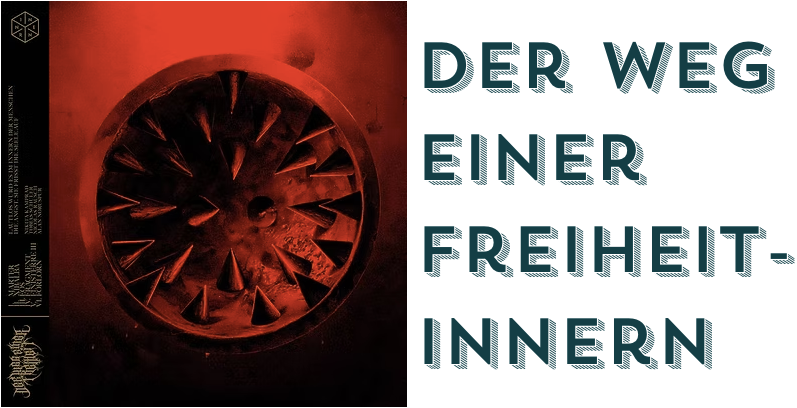
Increasingly, it seems that the balls-to-the-wall aggression that previously fuelled metal has been falling to the wayside: though genres like thrash continue to pile on the anger and brutality, there’s a massive amount of emotional space available for modern bands to explore. Der Weg einer Freiheit inhabit that area like it was made specifically for them, crafting black metal that aims to tug more at the heartstrings than the adrenal glands. New record ‘Innern’ may not be the most innovative post-metal album out there, but its sheer scale and thematic weight certainly go the distance regardless.
If ‘Innern’ is one thing, it’s big: the four-piece have gone out of their way to complement the album’s heavy lyrical themes with some of the most gigantic, all-consuming soundscapes you can find this year. The record is absolutely suffocating, piling on the guitars and keyboards until the listening experience feels like wading across the ocean floor. Opener ‘Marter’ takes a suitable length of time to build, kicking the record off on a greatly cinematic note with its grandiose keyboards and hurried drum hits— when the levy does finally break, Der Weg einer Freiheit unleash the heft of their sound. From a technical standpoint, ‘Innern’ is practically flawless. Kamprad and Rausch’s guitars blend together like elements of an orchestra, crashing around the sound stage with direction and purpose— they are undoubtedly the central focus here, even with the despairing vocals and boisterous drumming doing their absolute best to steal the show.
The six tracks presented on ‘Innern’ hardly feel like they were written by a metal band, as much as they were composed: the album isn’t comprised of riffs or conventional song structures, but rather the slow evolutions of a symphony. ‘Xibalba’ opens on the soundtrack to judgement day, thundering in with chord progressions that can only be described as epic— the way the song gradually brightens across its ten-minute runtime, becoming more sorrowful than vengeful, is captivating. The following ‘Eos’ is arguably even more heftier in its arrangement, letting loose the full force of Der Weg einer Freiheit: it’s the closest the record ever becomes to out-and-out black metal, twisted and overpowering as it is. ‘Innern’ may seem unassuming at times, but never let your guard down— when its momentum peaks, the album is absolutely unstoppable.
Those gargantuan crescendos rarely serve to get your head banging though, as much as they seek to capture a certain sense of agony: the thread that connects these moments to the softer passages of ‘Innern’ is the singular focus on atmosphere that comes to define the record. The solemn lone piano of ‘Finisterre III’— captured so that the instrument sounds far away, as if recorded in an empty amphitheatre— is chilling, providing a welcome break from the furious blast beats (but no reprieve whatsoever from the ever-present sorrow). Closer ‘Forlorn’ goes on to carry that torch, gliding its way through one of the softest and most cautious soundscapes on the album: the use of clean vocals (and in English, no less) really sets the cut apart, bringing this momentous journey to a satisfying, if bittersweet, conclusion. Der Weg einer Freiheit really don’t put a foot wrong here: every idea they attempt on their newest record flourishes.
Now, while the group certainly earn that praise, it’s also somewhat of a natural consequence of just how far inside the post-metal box ‘Innern’ is: Der Weg einer Freiheit are really not pushing the genre’s envelope here. The shifting moods of cuts like ‘Fragment’ and ‘Marter’ are interesting and evocative, certainly, but when all is said and done, they aren’t the most memorable pieces out there— the album lives and dies by its atmosphere, as post-metal always has. Ultimately, ‘Innern’ seems doomed to blend in with its contemporaries given time, as there aren’t all-too many bells and whistles being deployed here: this is more of a slight refinement of the genre than a reinvention, and the impression the album leaves does suffer considerably as a result.
That doesn’t mean the record can’t still carry immense artistic weight though: by contrast, the lyrical explorations across ‘Innern’ are one of its strongest attributes. Der Weg einer Freiheit’s latest work is greatly introspective, dealing with such important themes as the meaning of life and the burden of responsibility. Opener ‘Marter’ dives headfirst into a philosophical discussion on mortality, with Kamprad choosing to find a purpose in death (or, perhaps, simply coming up empty when it comes to the meaning of existence).
“Death is but a new beginning and it catches me
When my spirit and flesh gaze upon the stars again
Everything seems to matter just a little less
Or am I being, am I being deceived?”
The extreme sorrow the band evoke via their instrumental arrangements only serves to complement these lyrical choices, which are unrelentingly agonising— whether it’s serving up ferocious blast beats or quiet piano melodies, ‘Innern’ only sinks deeper into a depressive spiral with every passing moment. Underneath its grandiose exterior, the album displays a deep, tender vulnerability: it’s this, more than anything else, that makes Der Weg einer Freiheit’s latest album worth checking out.
“For I don't want to bear the weight
Of knowing hearts in these fragile states
So spare me the truth and let it all go
In silence where the shadows glow”
‘Innern’ is not the most interesting post-metal album you could hope to discover: as the genre goes, it’s somewhat by-the-numbers. What the record is, though, is moving— by that comment alone, you should know that Der Weg einer Freiheit have succeeded in their endeavours here. Though the album’s staying power seems up-in-the-air, the weight of its emotion and its atmosphere speak for themselves. ‘Innern,’ for all its black metal posturing, is beautiful.
Comments